Meet us at Farnborough International Airshow 2026
Application:

Heat exchangers

The problem

Thermal management is a hard constraint on modern platforms such as drone bodies, where every millimetre of internal volume and every gram of mass is contended for. Conventional coolant heat exchangers do not fit that reality.
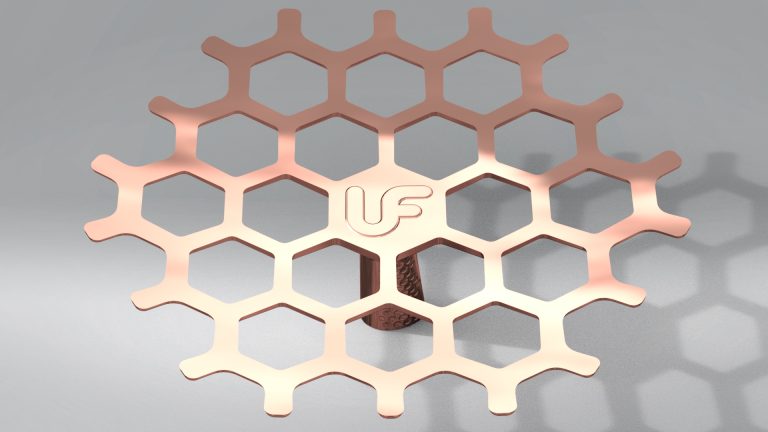
  • Heat exchangers for coolants in drone bodies come in standardised box shapes that take up space inefficiently.
  • High surface area solutions with tailored geometries cannot be manufactured through casting or sheet metal forming.

Our solution: 

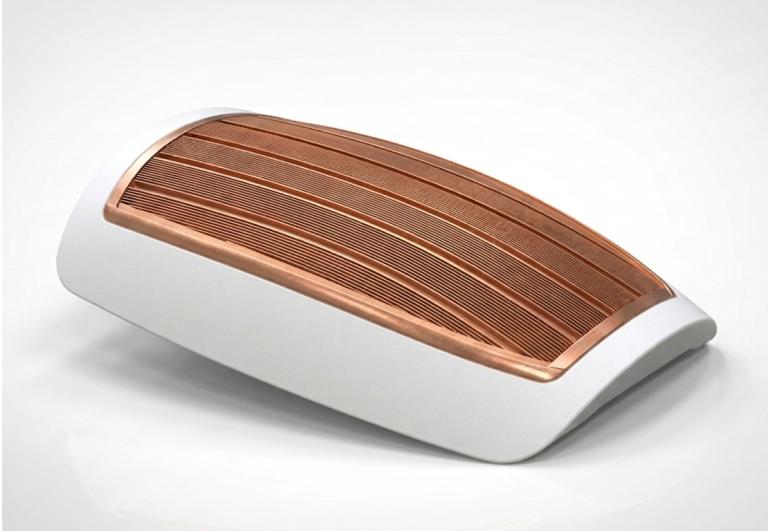
We electroform conformal heat exchangers that become part of the body shell itself, growing cooling geometries that cannot be made any other way.

  • Conformal 'active skin' heat exchanger that integrates into the body shell rather than occupying internal volume.
  • Fine, densely grouped channels created by electroforming, not possible through sheet metal fabrication.
  • Multilayer deposition that combines environmental protection (nickel) with conduction (copper) in a single wall.
  • Optimised design developed and refined through heat transfer modelling.
  • Space saving and lower weight than conventional heat exchangers.

Why it is better:

  • Space saving by design - the exchanger lives in the shell instead of a box inside it, giving back internal volume for payload and systems.
  • Lower weight - a thin electroformed skin weighs less than a conventional box unit of equivalent duty, saving mass where it costs endurance and range.
  • High surface area, tight packaging Fine, densely grouped channels pack a large heat transfer surface into small and awkward spaces.
  • Multilayer, modelled construction Copper conduction and nickel protection are graded into a single wall, with the channel layout tuned by heat transfer modelling.

More Applications